
National Team
Malaysia National Football Team Players: 2026 Guide
Who plays for the Malaysia national football team in 2026? A guide to the Harimau Malaya squad, key players, the banned naturalised seven and the U23 side.
Updated 20 August 2026 · Kedafa editorial

Every four years the question comes back: why is Malaysia not in the World Cup? A country of 34 million people, football-mad, with one of Asia’s oldest league traditions and a stadium that holds 87,500 — and yet Harimau Malaya have never appeared at a FIFA World Cup finals.
The short answer: Malaysia has never been close in the modern qualifying era, and the reasons are structural, not bad luck. Here’s the honest version.
Malaysia has never qualified because, for most of the last four decades, the team simply hasn’t been at the level where qualification was realistic. Asia’s World Cup places have historically gone to teams ranked in the world’s top 50–80 — Japan, South Korea, Iran, Saudi Arabia, Australia, Qatar. Malaysia’s FIFA ranking has spent most of the 21st century between 130 and 170. That gap — fifty to a hundred ranking places — is the whole story in one number.
It wasn’t always like this. In the 1970s Malaysia was one of Asia’s better sides. The team qualified for the 1972 Munich Olympics, beat the likes of Japan and South Korea in that era’s competitions, and produced players — above all Mokhtar Dahari — who belonged on a bigger stage.
The cruellest moment came in 1980: Malaysia qualified on merit for the Moscow Olympics, and then never went, because Malaysia joined the international boycott of the Games. For the generation of SuperMokh, Santokh Singh and Soh Chin Ann, that was the closest thing to a global tournament they would ever get. The World Cup itself was a different matter — in that era Asia often had just one or two places, so even Asia’s best routinely missed out.
Three long-running problems explain the decline from “good in Asia” to “struggling in Southeast Asia”:
The 2026 World Cup was the first with 48 teams, and Asia’s allocation grew to eight direct places plus a play-off. For federations like Malaysia’s, that changed the calculus: qualification stopped being fantasy and became a plausible project. FAM’s answer was aggressive recruitment of heritage and naturalised players.
It ended badly twice over. On the pitch, Malaysia exited in the second qualifying round. Off it, the programme produced the biggest scandal in the country’s football history: FIFA found that falsified documents had been used to register seven foreign-born players, and in March 2026 the Court of Arbitration for Sport upheld the sanctions. The full timeline is in our FIFA ban explainer — but the strategic consequence is that the shortcut Malaysia bet on is now closed.
There’s no mystery about what World Cup-standard federations do. For Malaysia the checklist looks like this:
Yes, in the way that all structural change happens: slowly, then suddenly. The 48-team format is a genuine opening; Southeast Asian neighbours have shown a decade of focused development moves a team 30–40 ranking places. Malaysia has the population, the money and the fanbase. What it has never yet had is the patience. Until that changes, the honest answer to “why is Malaysia not in the World Cup” stays the same: because the foundations were never built to World Cup depth — and foundations are the only route left.
No. Malaysia has never qualified for a FIFA World Cup. The senior team's biggest global near-miss came in Olympic football: Malaysia qualified for the 1972 Munich Games and earned a place at the 1980 Moscow Olympics, which the country then boycotted.
Malaysia was eliminated in the second round of Asian qualifying for the 2026 World Cup. The expanded 48-team format gave Asia more places than ever, but Malaysia's group results were not close to the standard required.
Malaysia's highest FIFA ranking was 75th, reached in August 1993, in the early years of the ranking system. As of June 2026 the team is ranked 136th.
It is mathematically possible but would require a dramatic improvement. Asia's allocation of 8+ places means a team ranked around 130 in the world must consistently beat sides ranked 40–100 in Asia's later qualifying rounds.
Who plays for the Malaysia national football team in 2026? A guide to the Harimau Malaya squad, key players, the banned naturalised seven and the U23 side.
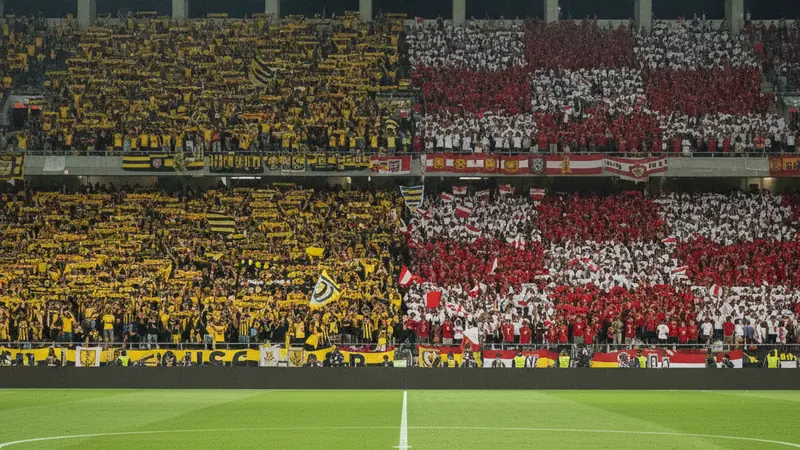
The Causeway Derby explained: how the Malaysia vs Singapore rivalry began in 1958, the head-to-head record, the three 6-0 wins and what the 2026 rout means.

The FIFA ASEAN Cup explained: how Malaysia went unbeaten yet missed the final on goals scored, FAM's stoppage-time complaint to FIFA, and the bronze match.