
National Team
Malaysia National Football Team Players: 2026 Guide
Who plays for the Malaysia national football team in 2026? A guide to the Harimau Malaya squad, key players, the banned naturalised seven and the U23 side.
Updated 5 October 2026 · Kedafa editorial
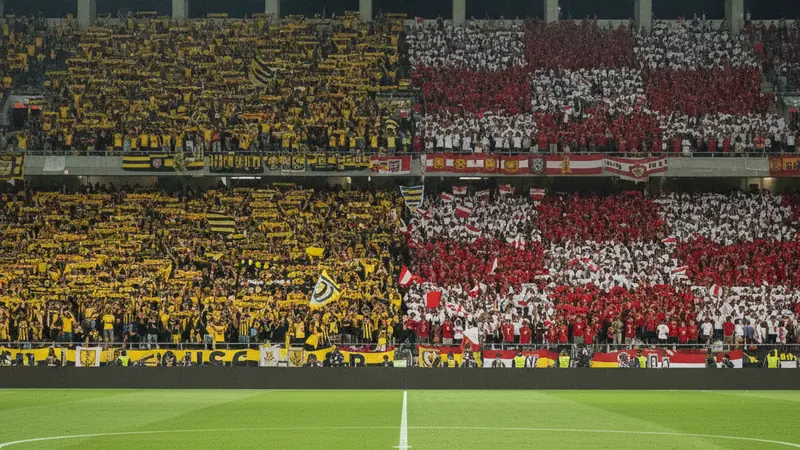
The Causeway Derby is the name for any football match between Malaysia and Singapore, two countries that were briefly one and have been arguing about it on a pitch ever since. The latest edition, on 1 October 2026 in Bandung, ended Malaysia 6-0 Singapore, a scoreline that equals the biggest margin in the fixture’s 68-year history. Malaysia leads the all-time series, which stands at 83 senior matches by our count, but the rivalry has rarely been one-sided for long. This page explains where the name comes from, who has actually won more, why Singapore spent seven decades playing in Malaysia’s domestic cup, and which matches people still argue about. It is current as of 5 October 2026.
The Causeway is the road-and-rail link across the Straits of Johor that has joined Johor Bahru to Singapore since 1924. Hundreds of thousands of people cross it every day, which is the point: this is a derby between neighbours who work, shop and eat in each other’s country, not between strangers. Singapore’s football association uses the name in its own match previews, and so do the Malaysian press, so unlike some “derby” labels dreamt up by broadcasters this one has stuck on both sides of the water.
The two teams carry animal identities that double as insults when the other side loses. Malaysia are Harimau Malaya, the Malayan Tigers. Singapore are the Lions, after the legend that gives the island its name. The Rec.Sport.Soccer Statistics Foundation, which keeps the most complete results list, files the fixture under the heading “a fight between Tigers and Lions”.
Malaysia, clearly, although the gap has opened and closed over the decades.
| Matches | Malaysia wins | Draws | Singapore wins | |
|---|---|---|---|---|
| RSSSF list, 1958 to Dec 2024 | 81 | 32 | 27 | 22 |
| Add Sep 2025 friendly and Oct 2026 FIFA ASEAN Cup | 83 | 34 | 27 | 22 |
Two caveats. RSSSF counts every senior international, including friendlies, and treats pre-1963 matches played as Malaya as part of the series. The Football Association of Singapore has used a different, smaller count in its previews, so you will see other totals quoted. The direction of the record does not change whichever list you use.
The biggest wins tell their own story. Malaysia’s record margin is 6-0, and it has been reached three times: in Jakarta in February 1976 during Olympic qualifying, in Kuala Lumpur in July 1978 at the Merdeka Tournament, and in Bandung in October 2026. Malaysia has also won 4-0 away, at the 2002 Tiger Cup in Singapore. Singapore’s best is 4-0, achieved in Bangkok at the 1979 King’s Cup and twice at home in the Merlion Cup, in 1985 and 1986. Singapore’s highest-scoring win is the 5-3 of July 2011, the first leg of a World Cup qualifying tie.
The national teams first met on 1 March 1958 in Kuala Lumpur, seven months after Malayan independence, and Malaya won 5-2. They played again the next day and Malaya won 3-1. At that stage Singapore was still a British colony, and the matches were friendlies between neighbours finding their feet. The politics arrived in 1963, when Singapore joined the new Federation of Malaysia, and hardened in August 1965, when it left. From then on a football match between the two was a contest between two sovereign states that had just had a very public falling-out, and the crowds treated it that way.
For the next quarter-century the derby was played mostly at tournaments rather than in competitive qualifiers: the Merdeka Tournament in Kuala Lumpur, the King’s Cup in Bangkok, the SEA Games, Singapore’s Merlion Cup. Malaysia had the better of the 1970s, with the two 6-0s and a 3-0 at the 1973 SEA Games in Singapore. Singapore had the better of the mid-1980s, winning three Merlion Cup meetings by a combined 10-0. World Cup qualifying brought them together in 1977, when Singapore won 1-0 at home, and in 1989, when Malaysia won 1-0 in Seoul and drew 2-2 in Singapore.
The oddity that makes this rivalry different from any other in Asia is that for most of the twentieth century Singapore was also a club in Malaysia’s domestic competition. The Malaysia Cup began in 1921 as the HMS Malaya Cup, and its first final was Singapore 2-1 Selangor. Singapore and Selangor met in the final again and again through the colonial decades, Selangor winning one of them 8-1 in 1927 and Singapore returning the favour 8-2 in 1933. By the time Singapore withdrew it had won the cup 24 times, a total that only Selangor, on 33, has bettered.
The club rivalry peaked in two eras. The first was the 1970s and early 1980s, when the teams contested six finals in seven seasons between 1975 and 1981 and the old National Stadium at Kallang produced the noise that Singaporeans still call the Kallang Roar. The second was 1994, when a Singapore side that included Fandi Ahmad won the Malaysian league and then beat Pahang 4-0 in the Malaysia Cup final to complete the double. It was the last thing Singapore did in Malaysian football: a dispute with FAM over gate receipts followed, Singapore pulled out, and the S.League was launched in 1996 as a replacement.
There were two sequels. From 2012 to 2015 the Football Association of Singapore sent a development side, LionsXII, into the Malaysia Super League under a memorandum with FAM. They won the league in 2013 and the FA Cup in 2015, beating Kelantan 3-1 at Bukit Jalil, and were gone the following season when FAM declined to renew the agreement. Separately, the Sultan of Selangor founded an annual match between a Selangor Selection and a Singapore Selection in 2001, originally as the Regent of Selangor’s Cup, to keep the old club rivalry alive. The Sultan of Selangor’s Cup returned in 2024 after a pandemic gap, and Selangor won the 2024 and 2025 editions 2-1 at Stadium Merdeka. Selangor leads that series 12 titles to 8.
Between the 2024 and 2026 meetings came a friendly on 4 September 2025 at Bukit Jalil, which Malaysia won 2-1 through Wilkin and João Figueiredo, with Ikhsan Fandi replying. Figueiredo was one of the seven players FIFA would suspend within weeks in the forged-documents case, which is why that result tends to get a footnote rather than a celebration.
The 83rd Causeway Derby was played at the Si Jalak Harupat Stadium outside Bandung as the final Group A match of the inaugural FIFA ASEAN Cup. Malaysia needed a win and a big one, because Indonesia were playing Bangladesh in Jakarta at the same time and only the group winner would reach the final.
They got the big one. A VAR review gave Malaysia a penalty for a foul by Ryhan Stewart on Fergus Tierney, and Bergson da Silva converted in the eighth minute. Stuart Wilkin doubled the lead in the 26th, Bergson scored again in the 62nd, Paulo Josué made it four in the 76th and Syahir Bashah five in the 87th before Bergson completed his hat-trick in stoppage time. Six goals is the most Malaysia has ever scored against Singapore, matching 1976 and 1978, and it came in a match played inside a FIFA window with both sides at something close to full strength.
It was still not enough. Indonesia beat Bangladesh 9-2, scoring twice in added time, and finished level with Malaysia on seven points and a plus-nine goal difference but with eleven goals scored to Malaysia’s nine. Indonesia took the final place on goals scored; Malaysia went to the third-place match against Vietnam. FAM has asked FIFA to explain why the added time shown in Jakarta changed from two minutes to seven. For Singapore the night was simply a humiliation, and the Lions’ supporters said so loudly online. Singapore finished the tournament with one win in three and a single goal.
The odd thing about the 2026 result is that it arrived with the two countries’ trajectories apparently pointing the other way. Singapore qualified for the 2027 AFC Asian Cup in November 2025 by beating Hong Kong 2-1, the first time it has reached the finals on merit and its first appearance since hosting the 1984 edition. Malaysia did not qualify, and spent 2025 and 2026 dealing with the FIFA sanctions, a change of coach and a rebuild of the national squad around domestic players and properly cleared newcomers such as Bergson and Brad Tapp. The FIFA ranking published in June 2026 had Malaysia 136th and Singapore 148th; the next update is due on 7 October 2026 and will move both.
No further Causeway Derby was scheduled as of 5 October 2026. The next competitive opportunities are the ASEAN Championship and whatever FIFA decides to do with the ASEAN Cup after its first edition, with friendlies always possible in a FIFA window. Whenever it comes, the record Singapore will be chasing is a four-goal margin from the 1980s, and the record Malaysia will be defending is three 6-0s, the newest of them from Bandung.
The name given to football matches between Malaysia and Singapore, after the road-and-rail Causeway that has linked Johor Bahru and Singapore since 1924. The senior national teams first met on 1 March 1958, when Malaya beat Singapore 5-2 in Kuala Lumpur.
Malaysia. RSSSF's list runs to 81 senior matches by the end of 2024, with 32 Malaysian wins, 22 Singapore wins and 27 draws. Malaysia has won both meetings since then, 2-1 in September 2025 and 6-0 in October 2026, which takes the tally to 34 wins from 83 matches.
6-0, achieved three times: in Jakarta in February 1976, in Kuala Lumpur in July 1978 and in Bandung on 1 October 2026, when Bergson da Silva scored a hat-trick. Singapore's biggest margins are 4-0 wins in 1979, 1985 and 1986.
Singapore was in the Malaya Cup from its first season in 1921, decades before either country was independent, and kept a team in the competition until 1994. Singapore won the cup 24 times, the last of them in 1994, then withdrew after a dispute with FAM over gate receipts and launched its own league in 1996.
Who plays for the Malaysia national football team in 2026? A guide to the Harimau Malaya squad, key players, the banned naturalised seven and the U23 side.

The FIFA ASEAN Cup explained: how Malaysia went unbeaten yet missed the final on goals scored, FAM's stoppage-time complaint to FIFA, and the bronze match.

FAM's 17 September 2026 election explained: how Ab Ghani Hassan beat Shahril Mokhtar 20–5, the new 11-member exco, and what the AFC-backed reforms change.